When a family decides to send a child on a study holiday abroad, the questions about language learning and cultural experience come quickly. But there is always another question — sometimes spoken, sometimes not — that sits underneath all the others: what happens if something goes wrong?
It is a reasonable question. Students are away from home, in a foreign country, in an environment they are not familiar with. Minor illnesses, sports injuries, allergic reactions, anxiety episodes — these are normal parts of life for young people, and they do not become less likely simply because someone is on a language programme.
At MLA World, we have built a welfare structure that takes this question seriously. One of its most distinctive elements is what we call Doctors on Campus: qualified, on-site medical professionals present at our centres throughout the season, integrated into our wider welfare and safeguarding system.
This article explains what Doctors on Campus means in practice, why it matters, and what it signals about the way MLA approaches student safety — for agents, schools, and the families who entrust us with their students.
What “Doctors on Campus” Actually Means
The term is straightforward, but the implications are significant.
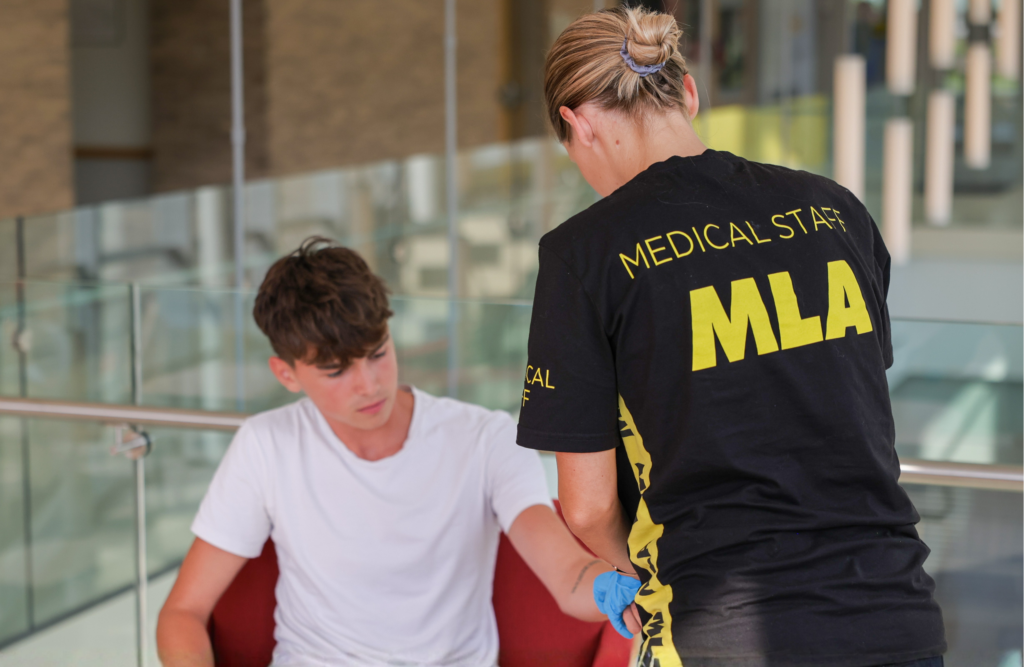
At MLA centres, medical support is not outsourced to a local clinic or handled through an emergency number. We have qualified medical professionals — doctors or medics, depending on the centre and country — physically present at the campus during the programme. They are part of the centre’s staff structure, not an external service called in when something goes wrong.
This means that when a student falls ill, sustains an injury during a sports activity, or presents with a medical concern at any point during the day or evening, there is a qualified professional on site who can assess the situation immediately. There is no waiting for a GP appointment, no uncertainty about where the nearest walk-in clinic is, no communication gap between welfare staff and external medical services.
The doctor or medic on campus works in direct coordination with the centre’s Welfare Manager, and with MLA’s central welfare team. Every medical interaction is documented. If a situation requires escalation — referral to a local hospital, contact with a student’s family, communication with a sending school or agent — that process is managed systematically, not improvised.
The Context: Why On-Site Medical Presence Matters
To understand why this matters, it helps to consider the context of a residential language programme.
A typical MLA summer centre hosts students from multiple countries, ranging in age from approximately 8 to 17 years old. They live on site, share meals, participate in group activities, attend classes, and go on excursions — all in an environment that is deliberately stimulating and social. This is the design. It is also what creates the conditions in which medical situations arise.
Young people at residential programmes experience a predictable range of health concerns: respiratory infections, digestive issues, minor injuries from sports and activities, heat-related discomfort in summer, headaches and fatigue from adapting to a new routine, and — particularly in the 13–17 age group — anxiety, homesickness, and the physical symptoms that can accompany emotional distress.
None of these situations are emergencies in the clinical sense. But all of them require prompt, competent assessment and appropriate management. In a residential setting with students who are minors, away from their families, in a foreign country, “competent assessment” means something specific. It means a professional who can distinguish between a student who needs rest and a student who needs to go to hospital. It means someone who can make that call at 11pm without waiting for a GP surgery to open the next morning.
This is what on-site medical staff provide. And it is a capability that generic welfare training — however thorough — does not fully replicate.
How Doctors on Campus Integrates with MLA’s Welfare System
The medical dimension of student welfare does not operate in isolation at MLA. It is part of a layered, integrated welfare structure that includes several complementary elements.
The Welfare Manager is the dedicated welfare professional responsible for the overall pastoral and safeguarding care of students at the centre. They are the primary point of contact for student wellbeing concerns and work in close partnership with the on-site medical staff. Where the Welfare Manager identifies a student who may have a medical need, the doctor is the immediate next step. Where the doctor identifies a student who may have a pastoral or safeguarding concern, the Welfare Manager is involved.
The 24/7 Emergency Contact ensures that qualified professional support is never more than a phone call away, regardless of the hour. This is backed by MLA’s central team, who provide operational and decision-making support to centre staff in any situation that exceeds the capacity of the on-site team alone.
Local Hospital and Emergency Service Links are established and maintained for every centre, so that if a student requires a higher level of medical care, the referral pathway is clear and pre-prepared. The on-site doctor is the professional who makes that referral decision, managing communication between the centre and the external facility.
Medical Documentation and Consent Forms are collected from families before the programme begins. This includes information on pre-existing conditions, current medications, allergies, and any specific medical instructions. This information is held by both the Welfare Manager and the on-site medical staff, so that if a student requires assessment, the treating professional has the relevant context immediately available.
Staff Safeguarding Training ensures that all MLA staff — not only welfare and medical professionals — are equipped to identify situations that require escalation. Centre Directors and Welfare Managers are trained to Level 2 or Level 3 safeguarding; general staff to Level 1. This creates an environment where potential concerns surface quickly, rather than being missed at the edges of the programme.
What This Means for Agents and Sending Partners
For agents and schools sending students on MLA programmes, the presence of qualified on-site medical staff has concrete implications for how you can communicate the programme to families.
Many parents — particularly those sending a child abroad for the first time — have concerns about medical support that go beyond what general welfare statements address. “There is a welfare officer on site” is reassuring but abstract. “There is a qualified doctor or medic on site throughout the programme, working as part of the centre team” is specific, verifiable, and materially different.
This is a differentiating factor in a market where many providers offer broadly similar programme structures. It reflects a level of operational investment in student safety that goes beyond the minimum requirements — and that is, for a significant number of families, a genuine deciding factor.
We encourage partners to present the Doctors on Campus element clearly in their communications. Families who ask the question — what happens if my child gets ill? — deserve a real answer. We have made sure that the answer is a good one.
A Reflection of a Broader Commitment
The Doctors on Campus model is not a feature that was added to MLA’s programmes in response to a regulatory requirement or a marketing trend. It is a reflection of how MLA has always understood the responsibility that comes with running residential programmes for minors.
When a student is at one of our centres, they are in our care. That means academic care, yes. It means social and pastoral care. And it means physical health care. These are not separate concerns that can be delegated to different departments or covered by different policies that never quite connect. They are all part of the same responsibility — to the student, to their family, and to the agents and schools who have recommended the programme.
The infrastructure we have built around student welfare — including on-site medical staff, trained welfare professionals, 24/7 emergency support, and systematic documentation — is the operational expression of that responsibility.
Conclusion
Sending a student abroad for a study holiday involves trust. Families trust the sending school or agent. The school or agent trusts the programme provider. And the programme provider — in this case, MLA — must have the systems in place to justify that trust in practice, not just in principle.
Doctors on Campus is one of the most tangible ways in which MLA makes that commitment concrete. It means that wherever one of our centres operates, there is a qualified medical professional on the ground, part of the team, ready to act when a student needs care.
For partners who want to know what happens behind the scenes to make MLA programmes safe, this is part of the answer. For families who ask the question that is always there underneath the others — we are ready with a real response.
If you would like further details about MLA’s welfare and medical support framework, or information specific to a particular centre or destination, please do not hesitate to get in touch with our team.