
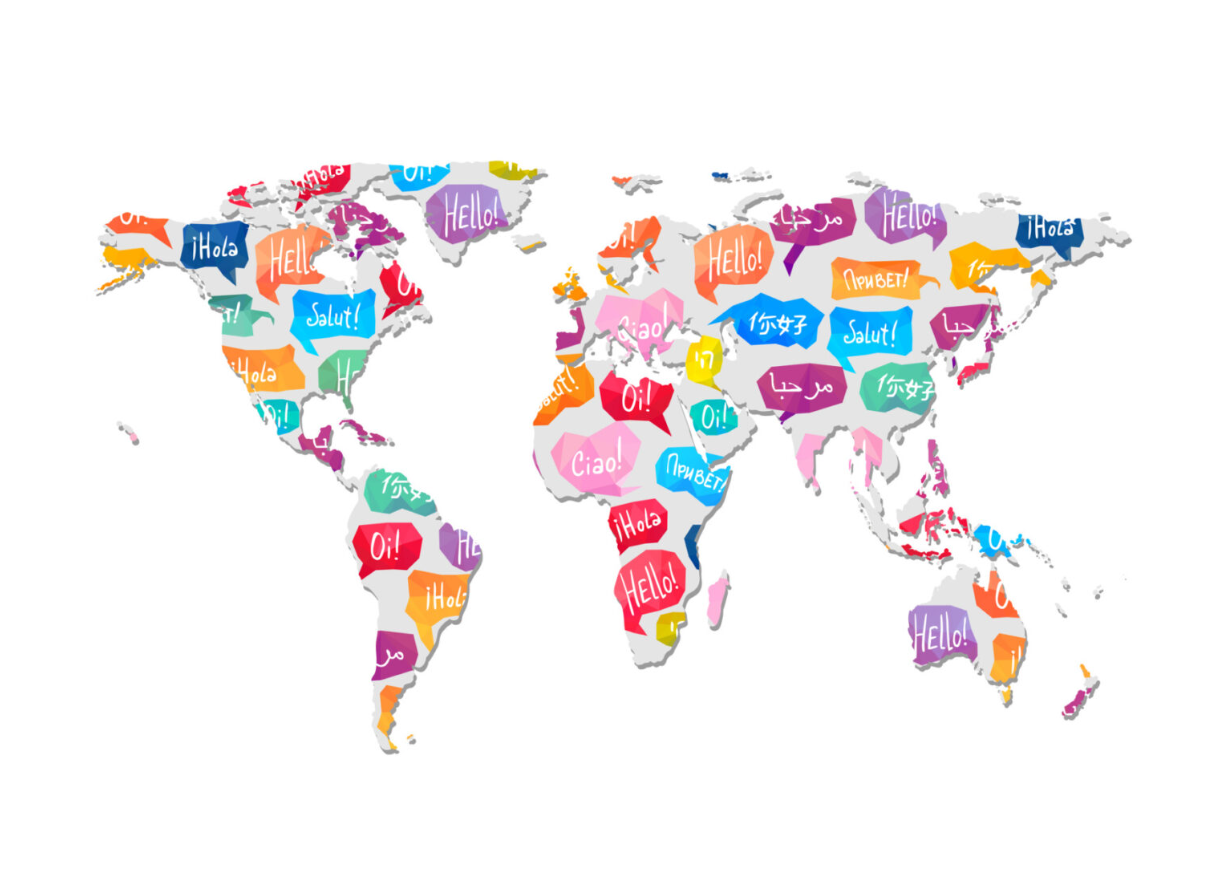
How many languages are spoken in the world? And why are there so many?
There are over 7,000 languages worldwide. On Malakula, the second-largest island of the Republic of Vanuatu (Melanesia), about 100 km long and 20 km wide, more than 40 different languages are spoken. Many scholars have therefore nicknamed it the Galápagos of linguistic evolution.
But why do so many languages exist?
There are still no definitive answers, but it is well known that many more languages are spoken in tropical regions than in temperate ones. For example, on the island of New Guinea there are over 900 languages, whereas in Russia – twenty times larger – “only” 105 indigenous languages are spoken. Scientists have observed that at low latitudes languages tend to be spoken in smaller, more restricted areas than at higher latitudes.
A very long time ago, everyone spoke the same language. Then migrations began. Humans left Africa and settled in other parts of the world. Geographic separation became linguistic separation. Even a small degree of geographic isolation is enough to create a local vocabulary.

Moreover, no people have ever remained completely isolated, and contact with other civilizations has further modified language, creating influences and giving rise to new languages.
Michael Gavin, an anthropologist at Colorado State University, built a model to understand how certain geographic, demographic, and climatic factors might influence the linguistic diversity of a given area. Starting from the languages spoken by Australian Aboriginal peoples before the arrival of Europeans, he identified 406 different languages.
He then considered that:
- Humans migrate into territories left unoccupied by other populations;
- Humans tend to populate areas where rainfall is abundant;
- Human populations have a maximum size, beyond which they begin to speak two different languages.
The model did not include socio-economic variables such as contact between neighboring populations, yet it produced a map of Australia showing 407 languages – just one more than the actual number. However, the model is more difficult to apply in other parts of the world.
In some areas, climate, population density, and landforms can produce linguistic diversity, but in other cases political or economic factors may play a more decisive role.